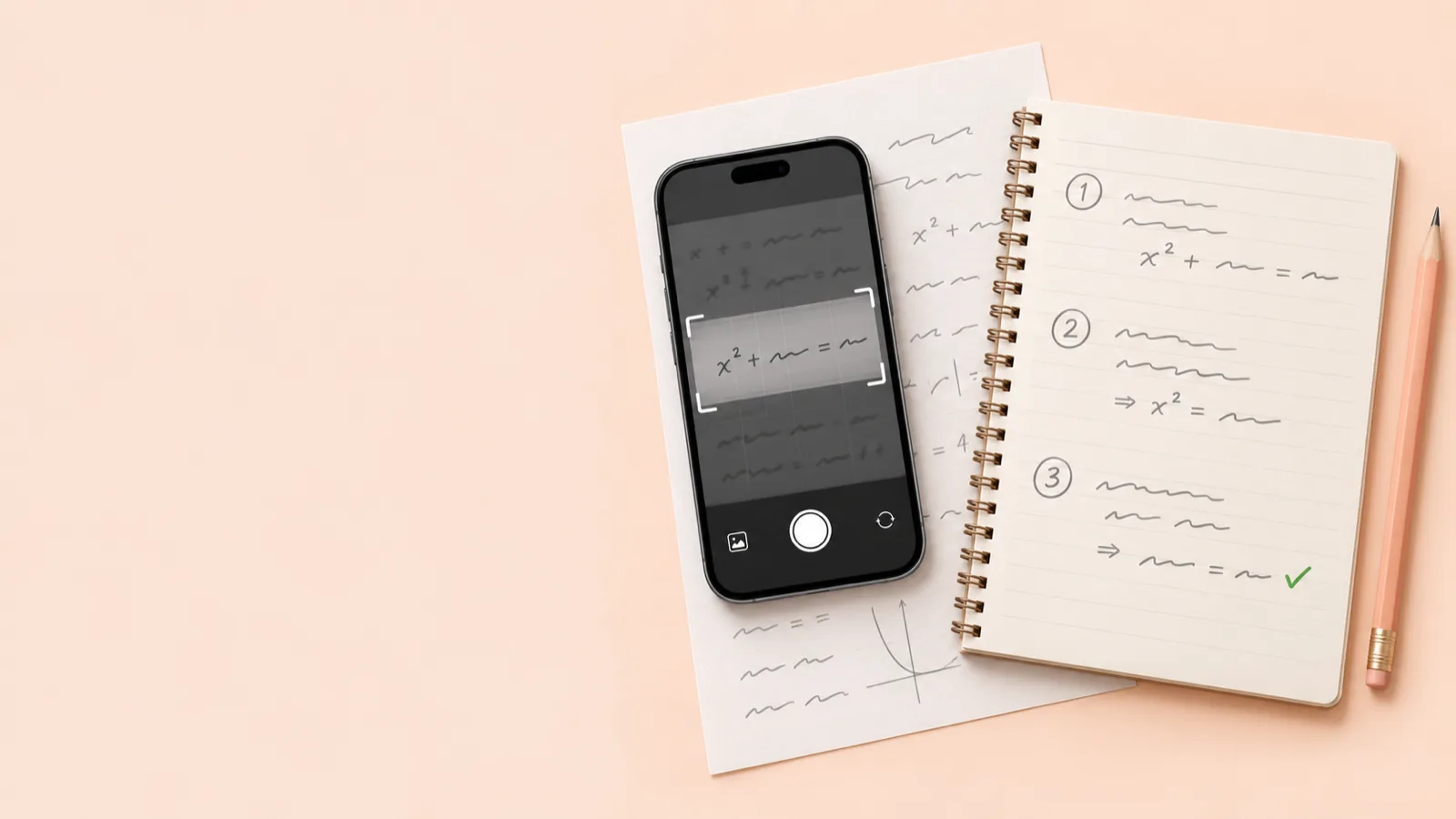
AI Homework Helper
Your first solve is free with no sign-up. Photos are sent only to solve the problem and are not stored.
Real examples: question → step-by-step help
Each solution below was made by this tool from the question shown, steps and all.
Example 1.Physics · Kinematics
Question
Output
Step 1.First, calculate the head start the first train gets. The first train travels from 2:15 pm to 3:00 pm, which is 45 minutes or 0.75 hours. Distance = Speed x Time = 72 km/h x 0.75 h = 54 km.
Why: To determine when the second train catches up, we first need to know how far ahead the first train is when the second train starts moving.
Step 2.Next, determine the relative speed at which the second train is closing the gap. Relative Speed = Speed of second train - Speed of first train = 96 km/h - 72 km/h = 24 km/h.
Why: When two objects are moving in the same direction, their relative speed is the difference between their individual speeds, indicating how quickly the distance between them changes.
Step 3.Now, calculate the time it takes for the second train to cover the head start distance. Time = Distance / Relative Speed = 54 km / 24 km/h = 2.25 hours.
Why: Knowing the distance to be covered and the rate at which it's being covered allows us to calculate the time required using the formula Time = Distance / Speed.
Step 4.Convert the decimal hours into hours and minutes. 0.25 hours x 60 minutes/hour = 15 minutes. So, 2.25 hours is 2 hours and 15 minutes.
Why: Converting decimal hours to minutes makes the time easier to understand and use for calculating the final catch-up time.
Step 5.Finally, add this time to the departure time of the second train. The second train left at 3:00 pm. Adding 2 hours and 15 minutes to 3:00 pm gives 5:15 pm.
Why: The catch-up time is relative to when the second train started its journey, so we add the calculated time to its departure time.
Answer: 5:15 pm
Check: At 5:15 pm, the first train has traveled for 3 hours (from 2:15 pm), covering 72 km/h * 3 h = 216 km. The second train has traveled for 2.25 hours (from 3:00 pm), covering 96 km/h * 2.25 h = 216 km. Since both distances are equal, the answer is correct.
Concepts → flashcards
Distance, Speed, Time Relationship · Relative Speed (Same Direction) · Unit Conversion (Time) · Calculating Head Start · Catch-up Time
Example 2.Chemistry · Balancing equations
Question
Output
Step 1.Identify the elements present in the equation: Iron (Fe) and Oxygen (O).
Why: The first step in balancing an equation is to know what elements you are working with on both sides.
Step 2.Count the number of atoms for each element on both sides of the equation. Reactants: Fe=1, O=2. Products: Fe=2, O=3.
Why: To balance an equation, the number of atoms of each element must be equal on both the reactant and product sides, according to the Law of Conservation of Mass.
Step 3.Start by balancing the element that appears in the fewest compounds. In this case, Fe. To balance Fe, place a coefficient of 2 in front of Fe on the reactant side: 2Fe + O2 → Fe2O3. Now, Reactants: Fe=2, O=2. Products: Fe=2, O=3.
Why: Balancing elements one by one helps to systematically achieve the overall balance.
Step 4.Next, balance the oxygen atoms. We have 2 oxygen atoms on the reactant side and 3 on the product side. To find a common multiple, multiply the O2 by 3 and Fe2O3 by 2: 2Fe + 3O2 → 2Fe2O3. Now, Reactants: Fe=2, O=6. Products: Fe=4, O=6.
Why: Coefficients are used to change the number of molecules, and thus the number of atoms, to achieve balance.
Step 5.Re-balance the iron atoms. We now have 2 iron atoms on the reactant side and 4 on the product side. Change the coefficient of Fe on the reactant side from 2 to 4: 4Fe + 3O2 → 2Fe2O3. Now, Reactants: Fe=4, O=6. Products: Fe=4, O=6.
Why: It is often necessary to re-adjust coefficients as other elements are balanced.
Step 6.Verify that all elements are balanced. Reactants: Fe=4, O=6. Products: Fe=4, O=6. The equation is now balanced.
Why: A final check ensures that the Law of Conservation of Mass is satisfied for all elements.
Answer: 4Fe + 3O2 → 2Fe2O3
Check: Count the atoms on both sides: Reactants have 4 Fe and 6 O. Products have 4 Fe and 6 O. Since the numbers match, the equation is balanced.
Concepts → flashcards
Chemical Equation · Reactants · Products · Coefficient · Law of Conservation of Mass
Example 3.History
Question
Output
Step 1.The Treaty of Versailles imposed harsh terms on Germany, including significant territorial losses, demilitarization, and substantial reparations payments.
Why: These terms were designed to punish Germany for its role in World War I and prevent future aggression, but they also created deep resentment.
Step 2.The 'War Guilt Clause' (Article 231) forced Germany to accept sole responsibility for starting World War I, which was a source of national humiliation and anger.
Why: This clause fueled a sense of injustice among the German population and provided a powerful propaganda tool for extremist groups.
Step 3.The economic burden of reparations, coupled with the global Great Depression, led to hyperinflation and severe economic instability in Germany.
Why: Economic hardship created widespread discontent, unemployment, and poverty, making the population vulnerable to radical political ideologies promising solutions.
Step 4.The treaty's limitations on Germany's military capabilities (e.g., a small army, no air force, no submarines) were seen as an infringement on national sovereignty.
Why: This demilitarization was perceived as a weakness and an insult, which Adolf Hitler later exploited by promising to restore Germany's military strength and national pride.
Step 5.Adolf Hitler and the Nazi Party capitalized on German resentment towards the Treaty of Versailles, using it as a central theme in their political propaganda.
Why: By promising to overturn the treaty, restore German honor, and rebuild the military, Hitler gained significant popular support, leading to his rise to power.
Step 6.Hitler's subsequent actions, such as rearming Germany, remilitarizing the Rhineland, and pursuing aggressive expansionist policies, directly violated the Treaty of Versailles.
Why: These violations, driven by the desire to undo the treaty's effects, ultimately escalated tensions and led to the outbreak of World War II.
Answer: The Treaty of Versailles contributed to the start of World War II by imposing harsh and humiliating terms on Germany, which fostered deep resentment, economic instability, and a desire for revenge, ultimately paving the way for the rise of Adolf Hitler and his aggressive policies.
Check: This answer directly addresses how the treaty's specific provisions (reparations, war guilt, territorial losses, demilitarization) created conditions that enabled Hitler's rise and subsequent actions, which are widely recognized as causes of WWII.
Concepts → flashcards
Treaty of Versailles · War Guilt Clause (Article 231) · Reparations · Demilitarization · Rise of Nazism
How the homework helper works
- Add the problem. Take a photo, upload a screenshot, or type it in.
- Work through the steps. Each step shows what to do and why. Reveal them one at a time, or all at once.
- Check the answer. A short check (substitute back, estimate, units) shows the answer holds up.
- Remember the method. Turn the concepts behind the problem into flashcards for spaced repetition.
Getting the best help
- One problem per photo. Crop to the question you are stuck on.
- Light and focus. A sharp, flat photo is read far more reliably than a tilted one.
- Say what you tried. Add a typed note like “I got 12 but the book says 8”.
- Try the next step first. Reveal one step, then try the next before you look.
Preparing for a test on the same topic? Make a practice quiz, or turn your class notes into a deck with the AI note taker. For unlimited problems, see Pro.
Frequently Asked Questions
Is this AI homework helper free?
Yes. You can solve your first problem without an account. Each solved problem uses one of your daily free generations (the same allowance as making a deck): 1 a day without an account, 5 a day with a free account, unlimited with Pro.
Can I upload a photo of my homework?
Yes. Take a photo or upload a screenshot of one problem. The photo is resized in your browser, read once to solve the problem, and not stored. You can also type or paste the question, or add a typed note to a photo.
Which subjects does it help with?
Maths (arithmetic to calculus), physics, chemistry, biology, economics, and written questions in history or English. It works best on one clearly stated problem at a time.
Does it just give the answer?
No. Every step says what to do and why that is the right move, and you can reveal the steps one at a time to try the next one yourself. At the end there is a way to check the answer and the concepts the problem relies on, which you can turn into flashcards in one click.
Is it always right?
It is told to work carefully and re-check its arithmetic, and it writes every step before the answer so the reasoning is visible. It can still make mistakes, especially on blurry photos or multi-part problems, so use the check at the end and compare with your class method.
Is using it cheating?
It is built for learning, like a tutor: it explains the method so you can solve the next problem alone. Follow your school’s rules about AI, and do the practice problems yourself.